


Europe’s Digital Independence: The Complete Guide to European Alternatives to Big Tech
Published on May 7, 2026
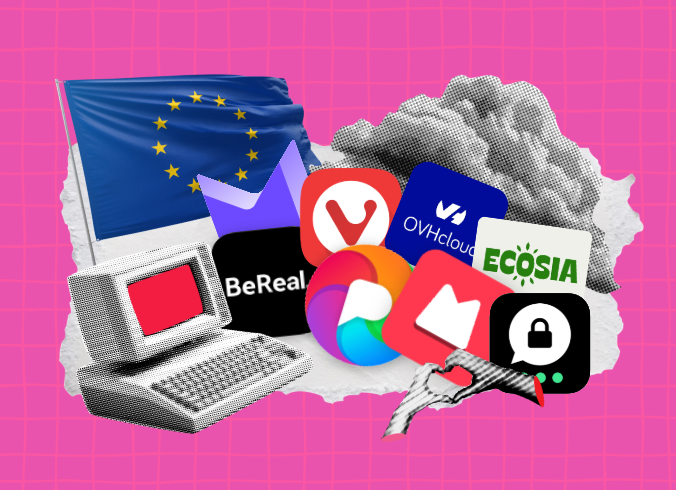
Are you considering switching to European alternative(s), then you found yourself in the right place. In this article, you’ll discover most of Europe’s alternatives to Big Tech. From search engines and email to cloud storage and social media networks. It’s time to build your sovereign digital stack and reduce the dependence on US tech. If you’re already familiar with what digital sovereignty is, just skip to the category you’re looking for. However, if you’d like to understand that a little bit better, let me tell you what sovereign digital stack is.
What Is a Sovereign Digital Stack in the Context of Europe?
A sovereign digital stack is the idea that a country, or an entire continent, should own, control, and operate the core layers of its digital infrastructure: from the operating systems and browsers citizens use daily, to the cloud servers storing sensitive public data, to the search engines shaping how people access information. In the European context, digital sovereignty means that Europeans are no longer comfortable outsourcing the plumbing of their digital lives to a handful of Silicon Valley corporations.
It is a concept that has moved, rapidly and decisively, from the fringes of tech policy into the mainstream of European political life. In November 2025, all 27 EU member states signed a declaration affirming their “shared ambition to strengthen Europe’s digital sovereignty” and reduce “strategic dependencies.” By the spring of 2026, France announced plans to migrate 2.5 million civil servants from Microsoft to Linux. Germany’s state of Schleswig-Holstein had already moved 80% of its government workplaces, 30,000 desks, off Microsoft products. A sovereign digital stack is no longer an abstract goal. It is becoming government policy.
How Europe Can Reduce Dependence on US Tech
The case for reducing dependence on US tech is no longer purely philosophical. It is legal, economic, and geopolitical. The US CLOUD Act compels American companies to hand over user data stored anywhere in the world, including on EU soil, upon government request. The 2020 Schrems II ruling by the Court of Justice of the European Union found that US law does not offer EU citizens adequate protection against American intelligence surveillance, effectively placing thousands of European organisations using US tools in a legal grey zone.
Meanwhile, US cloud providers, Amazon, Microsoft, and Google, control more than 70% of Europe’s cloud market. Spending on sovereign cloud infrastructure in European countries is forecast to more than triple to $23 billion by 2027, according to Gartner. The European Council on Foreign Relations has framed the question starkly: it is not whether Europeans can afford to build their own European tech stack, but whether they can afford not to. The practical answer is that Europeans can start reducing their dependence today, tool by tool, category by category, by switching to the growing ecosystem of credible, privacy-respecting, European-built alternatives to Big Tech.
European Alternatives to Big Tech
European Social Media Apps
(Alternatives to X/Twitter, Instagram, Facebook, LinkedIn, TikTok)

Social media is perhaps the hardest category to switch, given the network effects of US platforms. But European-built alternatives are emerging with a different model.
- Mastodon (Germany) — The most widely adopted European alternative to X/Twitter. Mastodon is open-source, decentralised, and run by a German non-profit. It has grown substantially among European journalists, researchers, and public institutions.
- Monnett (Luxembourg) — A European alternative to Instagram, launched in late 2025. Monnett has no algorithm, no AI-generated content, instead lets people decide what they want to see in their feed.
- BeReal (France) — The French photo-sharing app that rewards authenticity over performance, with its signature dual-camera prompt.
- XING (Germany) — A European alternative to LinkedIn, with 22.5 million users in German-speaking countries. It focuses on job listings rather than the engagement-maximising feed model of LinkedIn.
- WSocial (Sweden) — A newly announced European social platform being developed as a direct alternative to X, which has drawn widespread interest across the continent as calls for digital sovereignty grow louder.
- eYou (Romania) — A European social media platform similar to Facebook, built around trust, transparency, and data sovereignty. eYou features a built-in, AI-powered fact-checking system that lets users verify posts.
European Search Engine Options
(Alternatives to Google Search, Microsoft Bing)
 US search giants collect enormous volumes of personal data — search history, location, behavioural profiles — to power advertising businesses. European alternatives offer a different approach.
- Qwant (France) — One of the most established European alternatives to Big Tech in the search category. Qwant does not store search data or build personalised profiles, aligns with GDPR, and is co-building a European web index with Ecosia.
- Ecosia (Germany) — A privacy-first search engine with a climate mission: it uses ad revenue to plant trees. Ecosia does not share or sell personal data to third parties and is building an independent European index with Qwant.
- Startpage (Netherlands) — Delivers Google search results without the tracking. Startpage acts as a privacy layer, so you get familiar result quality under Dutch jurisdiction and GDPR protection.
- Swisscows (Switzerland) — A family-friendly, semantic search engine built on Swiss infrastructure, with no personal data logging. Its privacy jurisdiction under Swiss law is considered one of the strongest in the world.
- Mojeek (UK) — The alternative search engine without tracking, that puts people first.
European Browser Alternatives
(Alternatives to Google Chrome, Microsoft Edge)

The browser is the gateway to your digital life — and most popular browsers are built by the same companies running the world’s largest advertising networks.
- Vivaldi (Norway) — Built by former Opera developers, Vivaldi offers deep customisation, built-in tracker and ad blocking, and encrypted DNS. It is a feature-rich European browser alternative that positions itself as a privacy-respecting alternative to Chrome and Edge.
- Waterfox (UK) — A Firefox-based browser with no telemetry and anti-tracking protections enabled by default. Fully open source.
- Pale Moon (Netherlands) — An independent browser with a Dutch lead developer, favoured by institutions that need stability and legacy extension support.
European Email Providers
(Alternatives to Gmail, Microsoft Outlook, Yahoo Mail)
 Email is the backbone of personal and professional communication.
- Proton Mail (Switzerland) — European email alternatives to Big Tech. Proton Mail uses end-to-end encryption, stores all messages on Swiss servers, and offers zero-access encryption for stored mailbox content. It includes aliases, a calendar, and integrates with Proton Drive and Proton VPN.
- Tuta (Germany) — Formerly Tutanota, Tuta offers end-to-end encrypted email with no ads or trackers. German jurisdiction under GDPR.
- Mailbox.org (Germany) — A business-grade email platform with a variety of tools, including; calendar, contacts, and cloud storage. Strong focus on privacy and open standards.
- StartMail (Netherlands) — Secure and ad-free email stored on Dutch servers, with unlimited aliases.
European Chat and Messaging Apps
(Alternatives to WhatsApp, Signal, Slack, Telegram)
 While Signal is a strong privacy tool, it is US-based. European messaging alternatives keep data under EU or Swiss jurisdiction.
- Threema (Switzerland) — Regarded as the leading European messaging app for privacy. No phone number or email required to register; end-to-end encrypted. A strong alternative to WhatsApp for individuals and organisations.
- Wire (Switzerland/Germany) — A secure collaboration platform built for teams, with strong encryption. Used by enterprises and government bodies. A compelling alternative to Slack for businesses that require GDPR-compliance by design.
- Element / Matrix (UK) — An open-source, decentralised messaging platform built on the Matrix protocol. Element has been adopted by European governments and universities as a sovereign communication platform. The French government runs its own Matrix deployment.
- Olvid (France) — End-to-end encrypted, no phone number required to register, and no IP logging. Recommended by French cybersecurity authorities.
European Video Calling Platforms
(Alternatives to Zoom, Google Meet, Microsoft Teams)
 Video calls became critical infrastructure during the pandemic and most of that infrastructure is American. European digital sovereignty demands European alternatives.
- ClickMeeting (Poland) — A European webinar and video conferencing platform with strong GDPR compliance. Particularly well-suited for companies running recurring online events.
- Whereby (Norway) — A clean, browser-based video meeting tool with no download required. Norwegian-built, GDPR-compliant.
- Livestorm (France) — A French webinar and video events platform designed for marketing and customer engagement, with European data hosting.
European Cloud Storage Providers
(Alternatives to Google Drive, Dropbox, iCloud, OneDrive)
 US cloud providers can be compelled to hand over data stored on EU servers under the CLOUD Act. Choosing a European cloud is one of the most direct moves toward a truly sovereign digital stack.
- Proton Drive (Switzerland) — End-to-end encrypted cloud storage from the makers of Proton Mail. Files, metadata, and sharing links are all encrypted.
- Nextcloud (Germany) — The most widely used self-hosted European cloud storage platform. Governments, universities, and enterprises across Europe run their own Nextcloud instances. A direct alternative to Google Workspace for document collaboration.
- Tresorit (Switzerland/Hungary) — End-to-end encrypted managed cloud storage.
- Koofr (Slovenia) — An EU-based cloud storage solution, both for teams and individuals, bringing simple and efficient tools for accessing, storing, organising and managing files.
- OVHcloud (France) — A leading European cloud infrastructure provider focused on digital sovereignty, privacy, and open standards.
European Developer and Work Platforms
(Alternatives to GitHub, Slack, Notion, Google Workspace, Microsoft 365)
 The professional and developer ecosystem has long been dominated by US platforms. European tech stack alternatives are closing the gap.
- Baserow (Netherlands) — An open-source no-code database and project management tool, a privacy-respecting European alternative to Airtable and Notion.
- Cryptpad (France) — An end-to-end encrypted office suite including documents, spreadsheets, and presentations. A zero-knowledge alternative to Google Docs.
- OpenProject (Germany) — A German open-source project management and collaboration platform designed as a European alternative to Jira, Asana, Monday.com.
- KROCK.io (Estonia) — An Estonian media review and creative collaboration platform designed for video production teams, animation studios, agencies, and content creators.
- NapoleonCat (Poland) — A Polish social media management and customer engagement platform designed as a European alternative to tools like Hootsuite, Sprout Social, and Buffer.
European Learning Platforms
(Alternatives to Coursera, Udemy, LinkedIn Learning)
- OpenClassrooms (France) — A Paris-based online learning platform offering accredited programmes and professional certification paths, with particular strength in tech and digital skills.
- Iversity (Germany) — A European MOOC platform focused on professional development and university-level courses.
- Lairner (Germany) — A German language-learning platform positioned as a European alternative to Duolingo, focused on AI-assisted learning, spaced repetition, and broad multilingual coverage.
European Navigation and Maps
(Alternatives to Google Maps, Apple Maps, Waze)
 HERE WeGo (Netherlands) — Formerly Nokia Maps, HERE is a European mapping and navigation platform used by car manufacturers, logistics companies, and consumers. Offers offline maps and public transit routing.
- OpenStreetMap — The open-source, community-built world map, with a strong European open-source community presence. The backbone of dozens of privacy-respecting mapping apps.
- OsmAnd (Netherlands) — An open-source navigation app built on OpenStreetMap data, with full offline capability and no tracking. A genuinely sovereign navigation tool for everyday use.
- Organic Maps (Europe) — A fast, privacy-focused offline maps app for hiking, cycling, and driving, built on OpenStreetMap.
European Consumer Marketplaces
(Alternatives to Amazon, eBay, Etsy)

- Zalando (Germany) — Europe’s leading fashion and lifestyle marketplace, headquartered in Berlin, operating across 25 European markets.
- Allegro (Poland) — The dominant e-commerce platform in Poland and one of the largest in Eastern Europe, with over 22 million active buyers.
- Kaufland.de Global Marketplace (Germany) — A growing pan-European marketplace run by the German retail group.
- Back Market (France) — A French a marketplace for certified refurbishers, offering a sustainable alternative.
- Vinted (Lithuania) — Europe’s largest second-hand fashion marketplace, headquartered in Vilnius.
European VPN Providers
(Alternatives to NordVPN [Panama], ExpressVPN [British Virgin Islands])
 Not all VPNs are created equal — and jurisdiction matters enormously when it comes to data protection.
- Proton VPN (Switzerland) — From the makers of Proton Mail, Proton VPN operates under Swiss privacy law with a verified no-logs policy. Open source and independently audited.
- Mullvad VPN (Sweden) — Arguably the most privacy-hardened VPN in Europe. Mullvad does not require an email address to sign up and accepts anonymous payment including cash. Swedish jurisdiction, open source, audited.
- Nym (Switzerland) — A decentralized privacy network (mixnet-based), not a traditional centralized VPN.
Why It Matters: The Case for Europe’s Own Digital Future
The conversation about European alternatives to Big Tech is ultimately about more than which app you use to check your email. It is about the conditions under which European society operates in the digital age — and who sets those conditions.
Data protection is non-negotiable.
GDPR gives Europeans some of the strongest data rights in the world. But those rights are meaningless if the tools people use route their data through American companies subject to the CLOUD Act and US surveillance law. Choosing European providers is the practical expression of the rights Europeans already have on paper.
No outsourcing everything to the US.
When 70–85% of Europe’s cloud infrastructure is controlled by three American companies, Europe’s digital autonomy is, in meaningful terms, an illusion. The geopolitical risks became vivid when the US government began leveraging technology access as a bargaining chip in trade negotiations. As one European minister put it, digital sovereignty has become “a matter of national survival, not just IT policy.”
Supporting local innovation and jobs.
Every subscription to a European cloud provider, every email sent through a European service, every search made on a European search engine funds local engineering talent, local tax revenues, and local innovation ecosystems. The European tech stack is not just a defensive measure — it is an economic opportunity.
Values alignment.
The platforms Europeans use shape the information they see, the content moderated from their feeds, and the algorithms influencing their decisions. European-built platforms are built under European law, European values, and European accountability structures. That is a meaningful difference.
The good news is that switching to European alternatives to Big Tech no longer means sacrificing quality. From encrypted email to self-hostable cloud storage, from privacy-first search to decentralised social networks, the European digital ecosystem in 2026 is mature, capable, and ready. The question is no longer whether Europe has alternatives. It is whether Europeans will choose to use them.
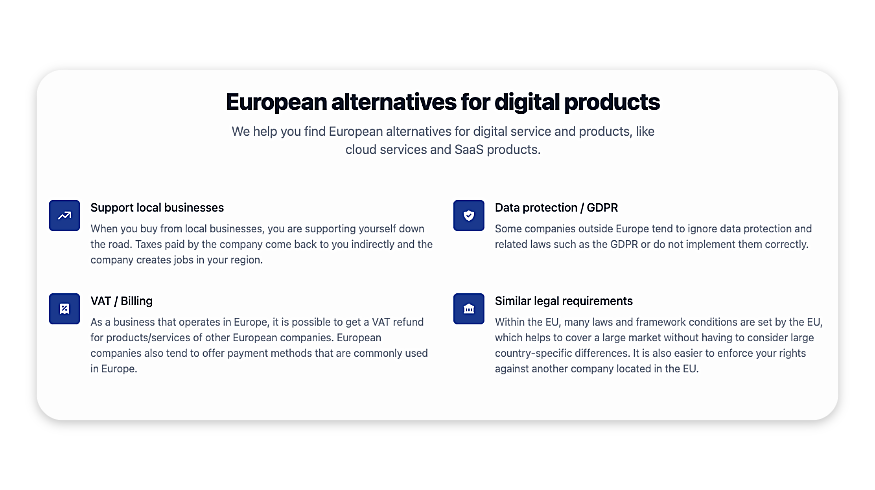
Looking to explore more European alternatives? Directories like european-alternatives.eu and switch-to.eu offer searchable databases of European-built tools across dozens of categories.
Join 100,000+ people
Be a person, not a user. Sign up and invite your friends to join you!
Related Articles
June 25, 2026
June 12, 2026

August 25, 2026