

5 Instagram Alternatives for Photographers
Published on September 27, 2026
When you search for “instagram alternatives for photographers” you always get the same handful of names in every article: Flickr, VSCO, maybe Glass. Most of these roundups treat every app as an interchangeable substitute for Instagram, but actually they each work for very different things, some for privacy, some for a calmer feed, a few for portfolios and licensing.
Since we’re building one said alternative, let’s look at how each one is different. Which ones actually help a working photographer get seen by the right people and turn that visibility into paid work, not just likes.
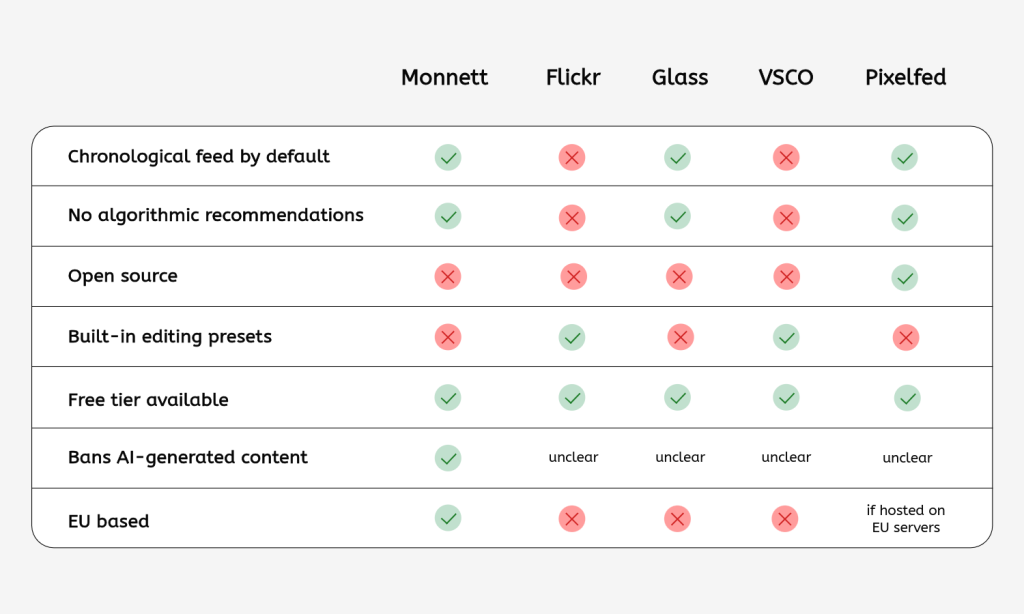
Instagram Alternatives for Photographers: Monnett vs. Flickr vs. Glass vs. VSCO vs. Pixelfed
1. Monnett
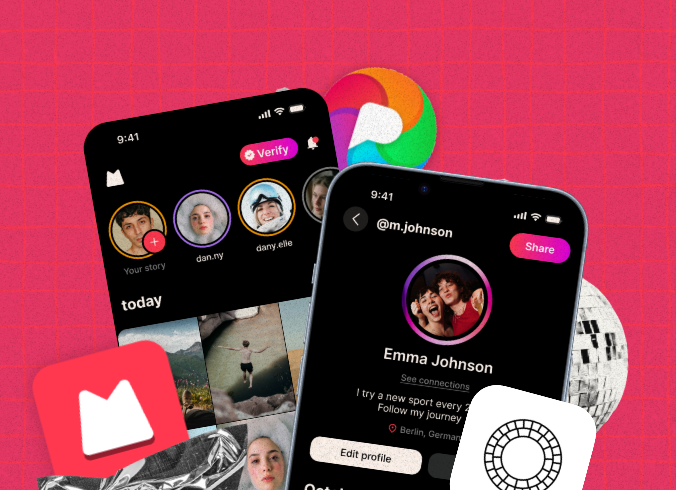
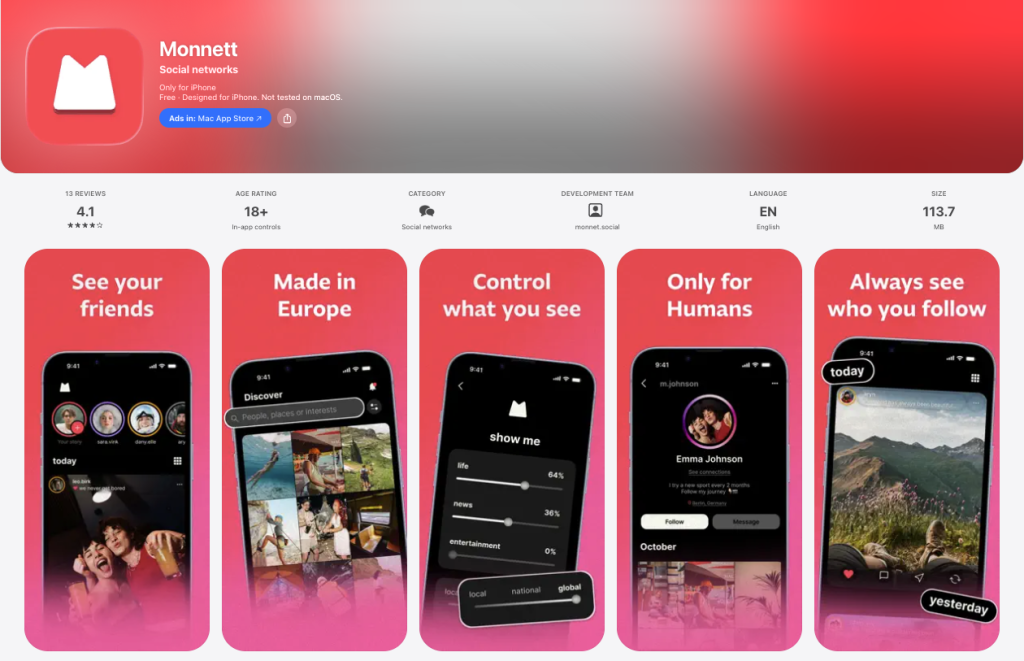
Monnett is a social media platform built to feel familiar, photos, video, stories, DMs, while fixing the two things that are the most problematic when you post your photography on Instagram: algorithmic reach and the single link in bio.
The app offers a chronological feed (perfect for photographers who just want to share their content). People just see posts in the order they’re published rather than in whatever order an algorithm decides is worth showing. But that is not all, the Home page will show you people that you follow. So if someone’s loving your work and they decide to give you a follow, your photography will always be there.
What else? If you’re a member you can have a link added straight to your post, meaning a caption about a new gallery can point straight to a booking page instead of sending someone to hunt for a link in bio.
Add GDPR-native infrastructure (Monnett is built in Luxembourg, with data stored in the EU) and you get a photo sharing app without an algorithm that doesn’t ask photographers to trade away a modern posting experience to get there.
Best for: Photographers who want a familiar app with fair reach and a direct link from post to booking. No algorithms influencing which content gets seen. An Instagram alternative that lets you link your website in posts, on every post, not buried in a bio.
Trade-off: The community is still growing (over 100,000 people so far) so a big audience isn’t what an established platform like e.g. Flickr offers.
Try it: App Store · Google Play
2. Flickr
Flickr launched in 2007 and has outlasted most of its early competitors. It’s seen renewed interest recently as photographers look elsewhere, and it still holds a massive archive of high-quality images alongside thriving niche communities. Group and album organisation also means photos tend to have a longer shelf life than on algorithm-driven feeds, post something into an active group, and it can keep circulating for months.
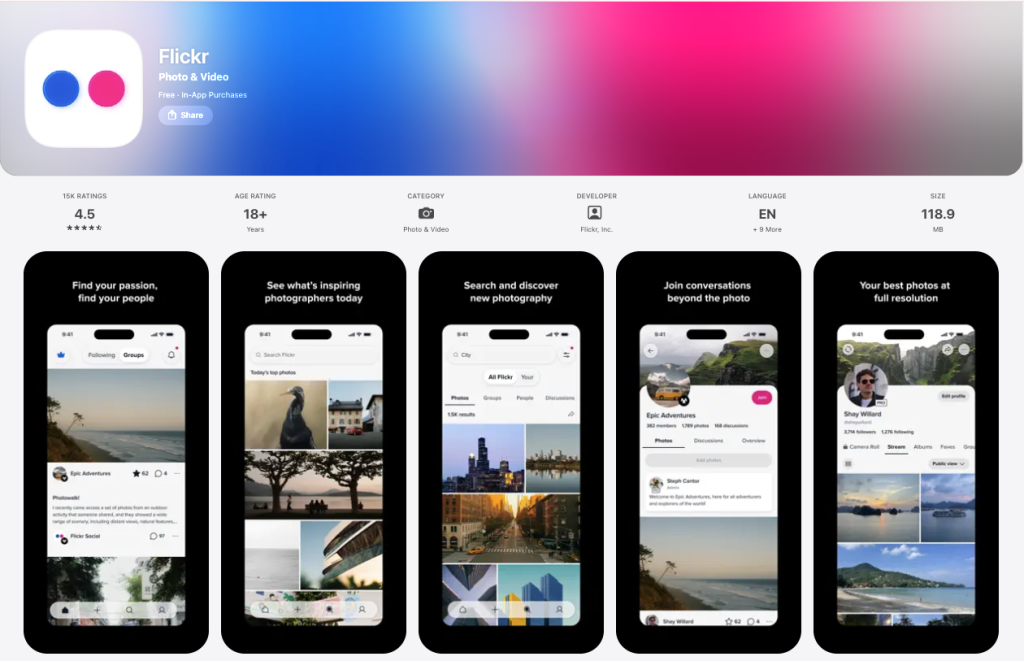
Best for: Archiving a large body of work and connecting with dedicated photography groups.
Trade-off: The audience leans toward other photographers and hobbyists rather than potential clients.
3. Glass
Glass is a paid, subscription-only app built specifically for photographers, with no public follower counts to remove some of the performance pressure of a typical feed. There’s no advertising and no engagement algorithm, the focus stays on photography itself,with categories and camera/lens-based discovery replacing the usual social metrics.
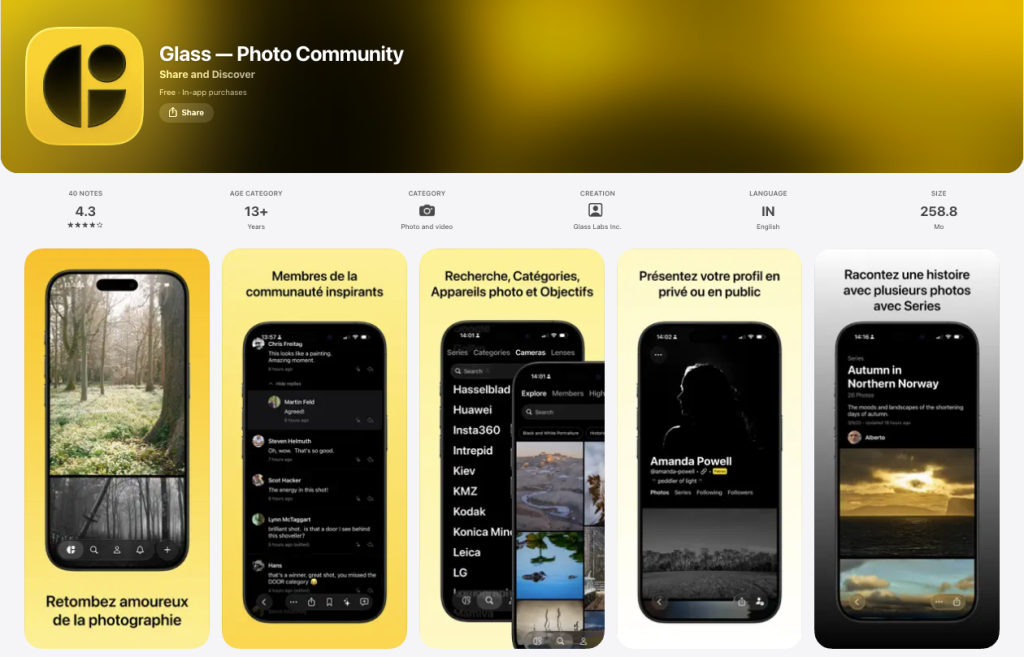
Best for: Photographers who want a slower, more serious community judged purely on the work.
Trade-off: The subscription fee and smaller membership mean less casual reach, fewer random eyeballs and less mainstream social energy than a free, open platform.
4. VSCO
VSCO started life as an editing app, but it has a real social layer underneath the filters, one built around visual storytelling without likes or public stats.That makes it a lower-pressure place to post moody or personal work without watching it get judged by engagement numbers.
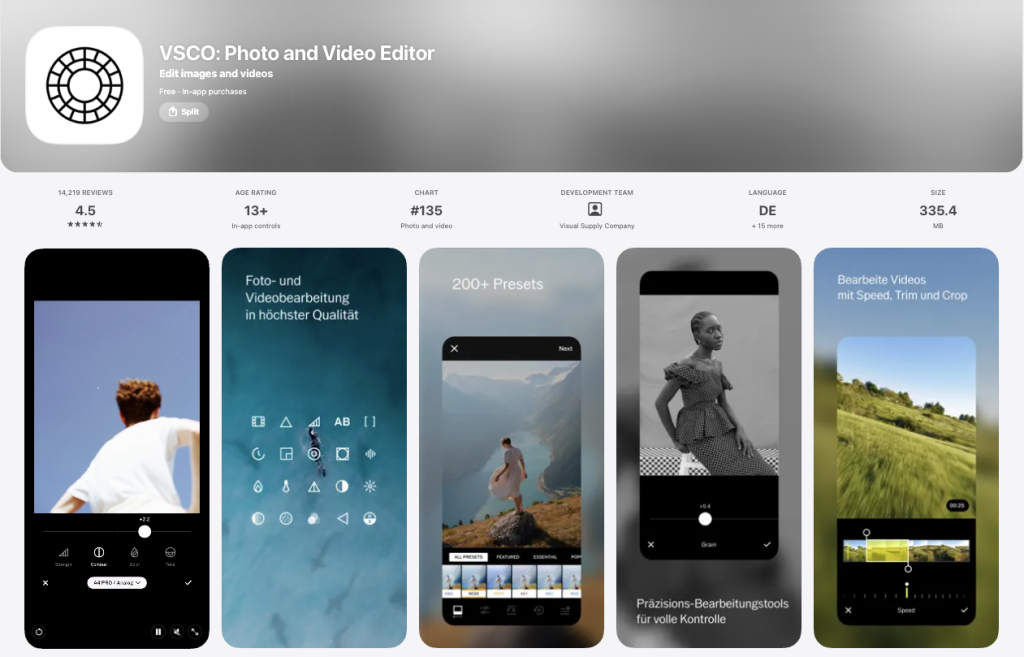
Best for: Photographers who want to share creative or personal work in a calm, aesthetics-first space.
Trade-off: VSCO isn’t built for discovery or client conversion, it’s better suited to personal expression than to growing a client base.
5. Pixelfed
Pixelfed is a federated, open-source photo-sharing network built on the same protocol as Mastodon.It looks and feels a lot like early Instagram, but it’s open-source and ad-free, with a chronological feed and no algorithmic interference, the closest thing to Monnett on this list when it comes to rejecting algorithmic reach.
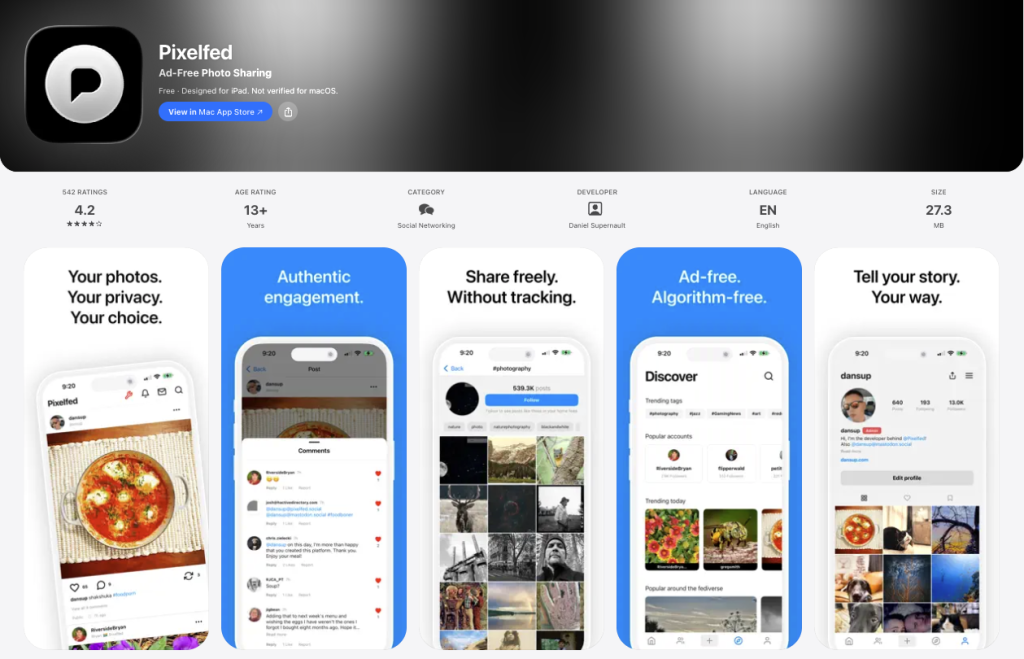
Best for: Privacy-focused photographers who want full control over their data and don’t mind a more technical setup.
Trade-off: Because the network is decentralised, each server has its own community, and discovery across the wider network is harder than on a centralised app , new users also have to choose a server before they can even sign up, which trips up plenty of people at the first step.
But How Do I Choose?
Most photographers end up running more than just one account at a time: somewhere to archive the full body of work, somewhere client-facing, and sometimes a quieter space just for personal shots. If the goal is turning an existing following into paid work, Monnett and Pixelfed are the two here built around a fair, non-algorithmic feed. The difference comes down to structure, Monnett keeps a centralised, familiar posting experience and puts a link on every post, while Pixelfed leans further into decentralisation at the cost of easier discovery.
The Bottom Line
If the frustration behind your search for an instagram alternatives for photographers is losing reach to an algorithm and losing clicks to a single bio link, Monnett is built to solve both directly. If archiving, community, or a slower creative pace matters more than conversion right now, Flickr, Glass, and VSCO each cover a different piece of that. And if you’re set on having an open-source platform above everything else, choose Pixelfed.
FAQ
Is there a free Instagram alternative for photographers?
Yes, Monnett, Flickr, VSCO, and Pixelfed are all free. Glass requires a paid subscription.
Do any of these apps let you link directly to your website in a post?
Monnett does, on every post with the membership. Most others, including Flickr and VSCO, still limit direct links to a single bio link, the same as Instagram.
Can I use more than one of these apps at once?
Yes, and many photographers do, pairing a client-facing platform with a separate one for archiving or personal work is a common setup.
Join 100,000+ people
Be a person, not a user. Sign up and invite your friends to join you!
Related Articles

June 30, 2026
May 4, 2026
September 10, 2026