


Building a human-centered European social network: interview with Christos Floros, founder of Monnett
Published on May 28, 2026
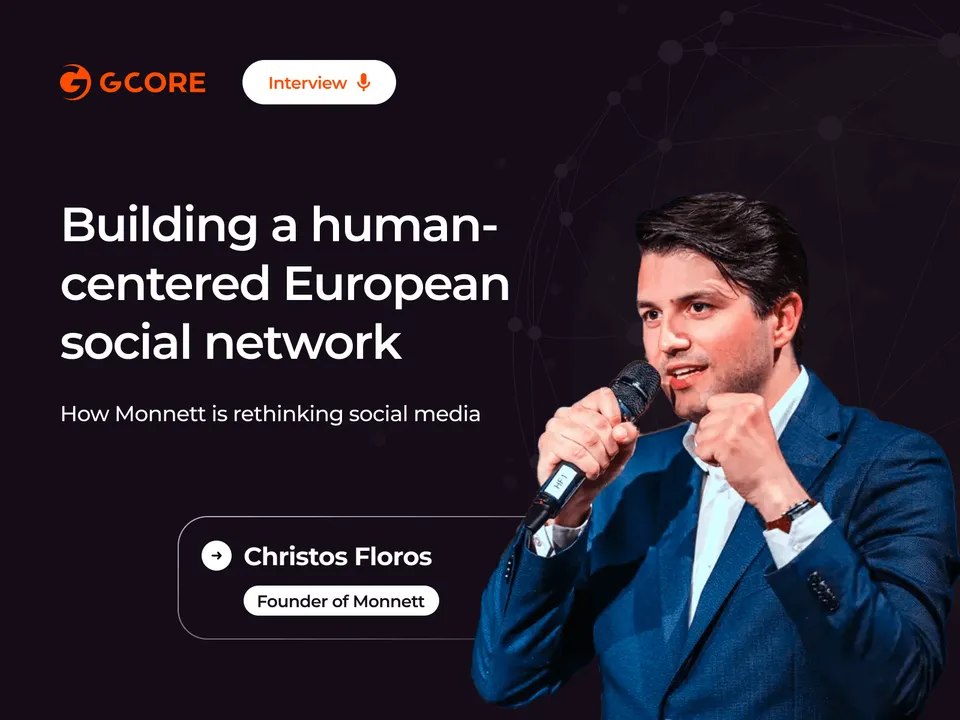
Social media has become one of the most powerful layers of modern civic life. It shapes how people communicate, how public opinion forms, how trust spreads — and how manipulation can scale. For Christos Floros, founder of Monnett, this is not just a product opportunity. It is a societal challenge.
Christos has moved through architecture, acting, media, politics, and technology. At first glance, that may look like an unusual path for a startup founder. But in conversation, the pattern becomes clear: each step has been connected to the same question — how can one contribute to making society better?
Monnett is his answer to that question today: a European social network built around human agency, trust, privacy, European data sovereignty, and a business model that does not depend on addictive algorithms.
Dima Maslennikov: Christos, let’s start with your background. Who are you, and how did you arrive at Monnett?
Christos Floros: I am a second-generation Luxembourger. I grew up with a strong connection to Europe, to Luxembourg, and to our social safety nets. Over the years, I have worked in media, in traditional media, and in tech and social media analytics. I have also been involved in politics because I believe we have a responsibility toward our societies.
Now I have started a company building a social network because I believe social networks are critical civic infrastructure. They are places where Europeans shape public opinion. And I believe we should continue to be able to shape public opinion ourselves, instead of allowing algorithms to shape it for us.
DM: You also trained as an actor. How does that part of your life connect with what you are building now?
CF: I spent three years training as a professional actor in the UK, and after that I worked as an actor.
That experience is very connected to what I do now. I very much believe in being human, in our humanity flourishing. I believe in the arts. I believe that everything we do, including technological innovation, should ultimately be done because we want to improve life. So we need to focus on life.
DM: You once performed in Richard III. When I looked at your background, I had the feeling that this also connects to Monnett. Richard III manipulates the audience directly. Monnett, on the other hand, seems to be about building something that does not manipulate people. Is that connection fair?
CF: I love the way you see it. I did perform in a production of Richard III in the UK, and Ian McKellen — Gandalf — actually came to see us on the night of the UK elections, which was phenomenal.
And yes, Richard III comes out on stage and starts talking directly to the audience. He complains. He tells people that society has become too soft, that people do not understand how hard things are. That is very topical today.
Increasingly, politicians tell us we should prepare for more difficult times. They push people toward extremes. At the same time, algorithms are dividing us. So the only way to push back is to rediscover the more essential things in life. And you can only do that when you reconnect people with each other, instead of letting algorithms dictate the relationship.
DM: When I look at your path — architecture, acting, politics, media, and now technology — I see one timeline. Architecture of physical spaces, architecture of digital spaces, performance, public opinion, and now a social network designed not to distract people but to reconnect them. Is that how you see it too?
CF: Most people do not see that, but I agree.
When you look at my background and ask one simple question — what is this guy trying to do? — the answer is clear. I am trying to make society around me better. I am trying to contribute to society.
When I was young, I thought I was going to do that through architecture. Then I realized that people listen to actors a lot more, so I wanted to be on stage and be seen. Then, when I saw clowns enter politics, I said: we cannot leave politics to clowns. So I entered politics.
But being in politics showed me that politics does not move fast enough. Not because politics is bad — democracy is very good, and I am a Democrat. But unfortunately, technological powers move much faster and innovate much faster than the technology of democracy itself.
So we need to offer technological tools that sustain our democracies.
DM: Let’s step back. What exactly is Monnett? What is the origin of the name? Is it connected to Jean Monnet?
CF: The connection goes back a long way.
My mother used to work for the European Commission in the Jean Monnet building here in Luxembourg. So Jean Monnet was always very present in my life. He was also instrumental in my education because when the European Schools of Luxembourg were founded, he was an early supporter of those schools as well.
There is a quote often attributed to that vision: Europeans educated side by side in Luxembourg would build Europe forward while still looking at their home countries with love. That idea stayed with me.
After the European elections in 2024, where I ran with the Democratic Party in Luxembourg, I realized that I was talking a lot about AI, technology, and AI sovereignty — but I was not happy with just talking about it. I needed to do more.
Then I was invited by the U.S. State Department to visit the United States and tour military bases as part of a NATO-related exercise. There, top military generals kept saying that one of the most important aspects of a country’s resilience — and its ability to defend itself — is civilian resilience. That means the ability of people to communicate with each other and to trust what they are seeing in the media and on social media.
We already live in a world where Donald Trump has said TikTok should be banned in the U.S. The United States looked at a foreign algorithm influencing what its citizens see and said: we do not want that. Benjamin Netanyahu called social media one of the most important weapons. I am not defending his politics, but the point is clear: world leaders understand what social media has become.
So I came back to Luxembourg and said: we need a Project Monnet for Europe. Just as Jean Monnet called for the reconstruction of France after World War II, we need a Project Monnet for Europe’s social platforms, because they are civic infrastructure.
The name also works as “Mon Network” — my network — with a French feel. That is where Monnett comes from.
DM: So what are you building in practical terms?
CF: We are building a social network in Europe. It is a European company, governed by the laws of the European Union, with data hosted by European providers like Gcore. But more importantly, we are building a product and a business model based on a different set of values.
The current business model of social media is broken because it is advertising-based. More time on the platform means more money. Therefore, addictive algorithms are profitable. That means the business is not aligned with the wellbeing of the user.
We are stripping that back. We are changing the business model. And we are removing algorithms from the product.
Instead of building better algorithms, we are saying: there should be no algorithm deciding what you see. People should see things in a humane way. When you post, your followers see the latest posts from the people they follow. You have human agency. You have your own brain. You have your own intelligence. You do not need an algorithm to notice that your girlfriend broke up with you and then show you ten videos that make you feel worse about it.
In a way, yes — we want to make social media great again.
DM: You mentioned NATO and resilience. Does that mean Monnett can also be seen as a dual-use product?
CF: Absolutely. We are absolutely dual-use.
But in order to have that secondary use, we first need to win the primary use… [Read more on Gcore]
Join 100,000+ people
Be a person, not a user. Sign up and invite your friends to join you!
Related Articles
March 9, 2026
June 30, 2026
August 25, 2026